We Have Been Mourning the Death of Community for Three Hundred Years

Photo: Vincent van Zeijst, CC BY-SA 4.0, via Wikimedia Commons
Somewhere in America right now, someone is writing an essay about how social media has destroyed genuine human connection. The argument will be earnest, well-sourced, and largely correct in its particulars. It will also be, in its essential structure, indistinguishable from a pamphlet circulating in Boston in 1740 lamenting that the old town meeting had been corrupted by faction and commerce. The details change. The grief does not.
This is not a defense of Facebook. It is an observation about the psychology of public space — specifically, the consistent human tendency to locate authentic community in whatever gathering place has just been displaced, and to condemn whatever has replaced it as a pale, corrupted imitation. The nostalgia itself is the only constant. The golden age it mourns has never been verified.
The Forum and Its Discontents
The Roman forum began as a market and a meeting ground, a place where commerce, politics, and religious ritual occupied the same muddy rectangle. By the late Republic, Roman writers were already eulogizing it. Cicero complained that the forum of his own era had become a theater of performance rather than a space of genuine civic deliberation. Juvenal, writing a century later, described the crowds there as a mob incapable of serious thought. Each generation of Roman intellectuals looked backward to an earlier forum — quieter, more dignified, populated by serious men — that the historical record suggests never quite existed in the form being mourned.
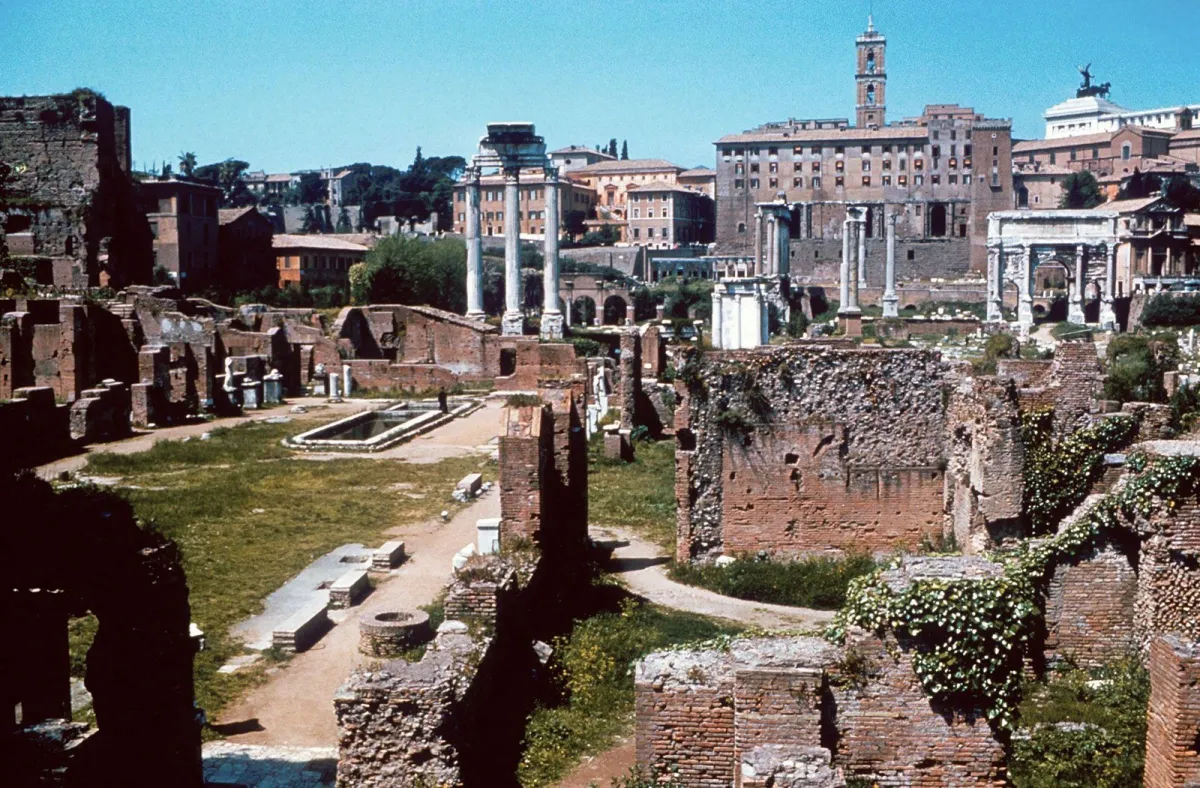 Photo: Roman forum, via cdn.britannica.com
The psychological mechanism is consistent across civilizations: the idealized gathering place is always located one generation prior to the writer's own experience. It is always described as having been destroyed by commercialization, by the wrong kind of people, or by some new technology of communication that has made genuine presence unnecessary. The Romans blamed political spectacle. Later generations would blame the printing press, the railroad, the telegraph, and the automobile, in roughly that order.
The New England Commons and the Myth of the Town Meeting
American nostalgia for community has a specific founding document: the New England town meeting. In the civic imagination, this institution represents democracy in its purest form — neighbors gathering on a common green to deliberate as equals, unmediated by party machinery or professional politicians. Alexis de Tocqueville celebrated it. Generations of political theorists have cited it. It remains the rhetorical gold standard against which every subsequent form of democratic participation is measured and found wanting.
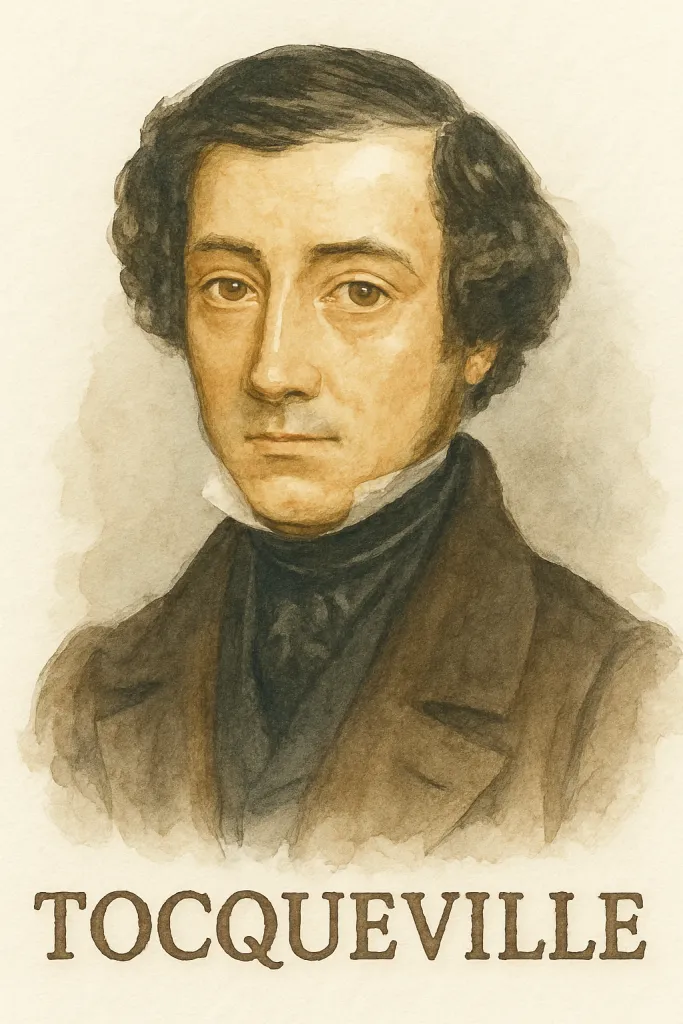 Photo: Alexis de Tocqueville, via tomascipriani.it
The historical record is considerably less romantic. Attendance at colonial town meetings was frequently poor. Participation was restricted by property qualifications that excluded most residents. Deliberations were often dominated by a small number of prominent families. The commons itself, that symbol of shared civic space, was in many towns a source of persistent conflict over grazing rights, fencing obligations, and competing commercial uses. The pastoral image of neighbors reasoning together in good faith was, in large measure, a retrospective construction — assembled most energetically by the very generation that was watching industrialization transform New England beyond recognition.
By the mid-nineteenth century, the railroad had produced the commercial downtown, and the town meeting was already being described as a lost ideal. By 1900, the downtown itself had become the authentic gathering place whose decline would later be mourned.
The Mall as Fallen Eden
The regional shopping mall arrived in postwar America as a deliberate attempt to recreate the town center that suburban development had eliminated. Victor Gruen, the architect who designed the first enclosed mall, was explicit about this ambition. He envisioned a climate-controlled commons where civic life, commerce, and community would coexist — a corrective to the sprawl that had atomized American neighborhoods. For roughly three decades, the mall functioned as the de facto public square of suburban America. Teenagers congregated there. Political candidates held rallies there. Community organizations set up tables near the food court.
Then the internet arrived, and the mall became the symbol of everything shallow and commercial that had destroyed authentic community. The same space that had been celebrated as a civic corrective was now indicted as the primary instrument of civic corrosion. Essays appeared mourning the genuine human connection that had existed before the mall replaced the downtown. Those essays were written by people who had, as children, spent their afternoons in the mall mourning the downtown that the mall had replaced.
The cycle completed itself with uncomfortable speed. Within a single lifetime, the mall moved from solution to problem to object of nostalgia — a trajectory that now includes Instagram accounts dedicated to photographing its ruins with evident tenderness.
The Algorithmic Commons
Social media platforms followed the same arc at accelerated velocity. Facebook, Twitter, and their successors were initially celebrated — and this is worth remembering — as tools for democratic community-building. The Arab Spring generated breathless coverage of how social platforms had restored the public square to populations denied physical assembly. American commentators described these spaces as the new agora, a phrase deployed with genuine enthusiasm rather than irony.
Within a decade, those same platforms had become the primary evidence that authentic community was dead. The critique was familiar: too commercial, too performative, dominated by the wrong voices, incapable of supporting genuine deliberation. The argument was structurally identical to Cicero's complaint about the late Republican forum, delivered at roughly the speed of a push notification.
What the Pattern Reveals
The persistence of this cycle across three thousand years of recorded history suggests something important about human psychology that no experiment on college students is likely to capture: people do not simply inhabit public spaces. They invest them with meaning, then experience their transformation as a form of loss, then reconstruct the prior version as an ideal it never achieved.
This is not mere sentimentality. The grief is real. Something genuinely is lost each time a gathering place transforms or disappears — the specific textures of a particular community at a particular moment cannot be fully reproduced. But the claim that what came before was categorically more authentic, more democratic, more genuinely communal, is almost never supportable when examined against the historical record.
The New England commons was contested and exclusionary. The downtown was stratified by race and class. The mall was designed by a corporation to maximize dwell time and retail spending. The forum was, by the end, a stage set for political violence. Each was real. None was a golden age.
What Americans have been mourning for three hundred years is not a specific lost place but a specific lost feeling — the sense that community is effortless, that belonging requires no negotiation, that the public square contains everyone and excludes no one. That place has never existed. The longing for it, however, appears to be permanent, and it transfers reliably onto whatever gathering space has most recently been displaced.
The next version of the commons is already being built. In ten years, someone will write an essay mourning its loss.