The Enemy Shaped Hole: How Nations Scramble to Fill the Void Left by Vanquished Foes
The Institutional Addiction to Opposition
In 146 BCE, Roman legions finally razed Carthage to the ground, ending a rivalry that had defined Roman identity for over a century. Within twenty years, Rome had manufactured new existential threats from Germanic tribes, internal conspiracies, and slave rebellions. The pattern was so swift and complete that historians now recognize it as the first documented case of what political scientists call "threat substitution" — the institutional reflex to replace a vanquished enemy with a new one.
This wasn't unique to Rome. It represents one of the most consistent patterns in recorded political history: governments organized around opposition cannot psychologically survive without an adversary to define themselves against.
The American experience offers the clearest modern example. For forty-five years, from 1945 to 1991, the Soviet Union provided the organizing principle for American foreign policy, domestic spending priorities, and national identity. The Cold War wasn't just a geopolitical reality — it was the foundational assumption underlying everything from highway construction to university research funding.
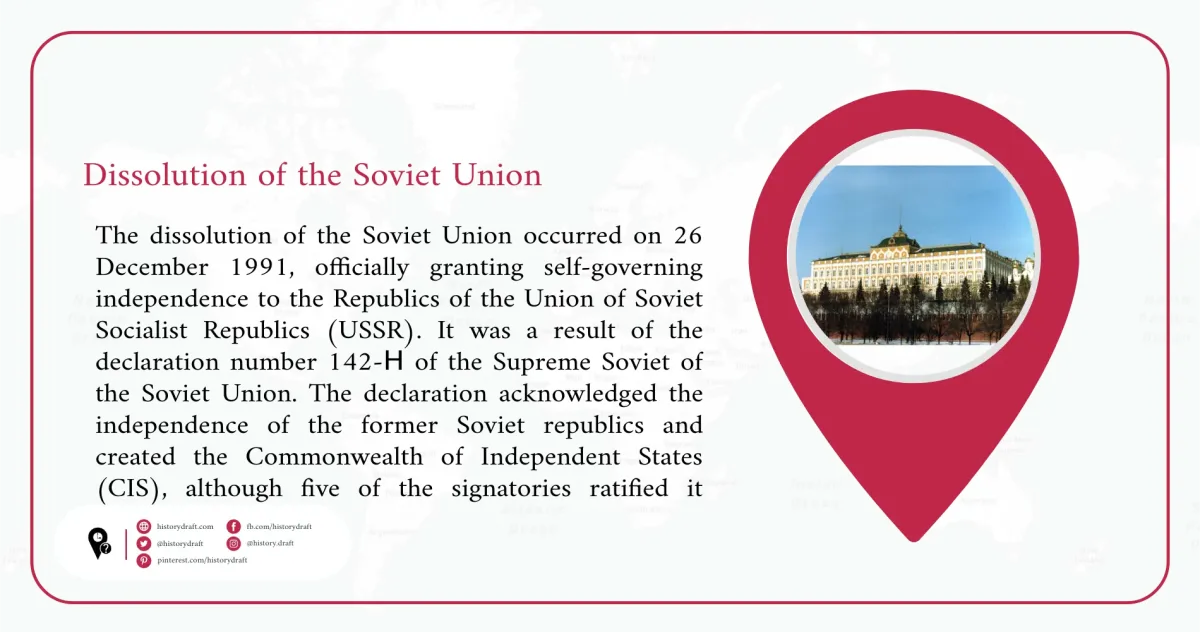 Photo: Soviet Union, via historydraft.com
Then, in December 1991, the Soviet Union simply ceased to exist.
The Scramble for Substitutes
What happened next validates every prediction that emerges from studying similar historical transitions. American policymakers didn't celebrate the victory and pivot to domestic priorities. Instead, they began an immediate and frantic search for replacement threats.
The timeline is instructive. By 1993, less than two years after Soviet collapse, American foreign policy establishments were already promoting "rogue states" as the new organizing threat. By 1995, terrorism had emerged as a primary concern. By 1997, China was being repositioned as a potential peer competitor. The September 11 attacks didn't create America's need for a new enemy — they simply resolved the competition between several candidates.
This mirrors the Roman experience with uncanny precision. After Carthage's destruction, Rome's political class didn't demobilize its military or reduce its territorial ambitions. Instead, they immediately identified new threats: Jugurtha in North Africa, Mithridates in Asia Minor, various Germanic confederations along the Rhine. Each was elevated to existential status and used to justify the same institutional structures that had been built to fight Carthage.
The pattern appears across cultures and centuries. After Spain expelled the Moors in 1492, ending nearly eight centuries of religious warfare, the Spanish monarchy immediately launched campaigns against Protestant heretics, Ottoman Turks, and New World populations. The institutional machinery of the Reconquista simply found new targets rather than disbanding.
The Psychology of Institutional Survival
This isn't conspiracy — it's psychology. Organizations built around opposition develop what historians call "adversarial dependency." Their personnel, budgets, and cultural identity become so intertwined with fighting a specific enemy that the enemy's disappearance creates an existential crisis.
Consider the American defense establishment in 1991. Millions of jobs, hundreds of billions in annual spending, and entire regional economies depended on the continued existence of a Soviet threat. The Pentagon didn't employ people who wanted to find peaceful solutions to international problems — it employed people whose expertise, career advancement, and professional identity required the existence of serious military threats.
When the Soviet Union collapsed, these institutions faced a choice: dramatically downsize and accept irrelevance, or identify new threats that justified their continued existence. Human psychology makes the outcome predictable.
The same dynamic appears in domestic politics. After the Civil Rights Movement achieved its major legislative victories in the 1960s, civil rights organizations didn't declare victory and disband. Instead, they identified new forms of discrimination, expanded their definitions of civil rights, and found new battles to fight. This wasn't cynicism — it was institutional survival.
The Speed of Replacement
What makes this pattern particularly striking is its speed. Historical analysis reveals that threat substitution typically occurs within 18 to 36 months of an enemy's elimination. This timeline appears consistent across different political systems, cultures, and historical periods.
The reason is institutional momentum. Organizations built around opposition maintain extensive intelligence networks, analytical capabilities, and communication systems designed to identify and publicize threats. When their primary target disappears, these systems don't shut down — they redirect their focus to secondary targets, often magnifying minor threats into major concerns.
Rome's intelligence networks, originally developed to monitor Carthaginian activities, seamlessly shifted to tracking Germanic movements and internal conspiracies. American intelligence agencies, built to penetrate Soviet operations, immediately began expanding their focus to terrorism, narcotics trafficking, and cyber threats.
The Inevitability of Succession
This pattern suggests something uncomfortable about how human institutions operate. Organizations don't naturally dissolve when they achieve their stated objectives. Instead, they redefine their objectives to ensure their continued relevance.
The implications extend beyond foreign policy. Any institution built around fighting a specific problem — whether it's a government agency, advocacy organization, or corporate division — faces the same psychological pressure to find new problems when the original one disappears.
Understanding this pattern doesn't require cynicism about institutional motives. It simply requires recognizing that human psychology hasn't changed in five thousand years. People whose careers, identities, and social relationships are built around opposing something cannot easily accept that the opposition is no longer necessary.
The enemy-shaped hole in institutional psychology gets filled because it must be filled. The only question is what will fill it, and how quickly the substitution will occur.