The Medicine Cabinet's Dark Mirror: How America's Greatest Healers Became Its Most Dangerous Dealers

The Recurring Prescription
In 1898, the Bayer pharmaceutical company introduced heroin as a cough suppressant, marketing it as a safe, non-addictive alternative to morphine. Doctors prescribed it enthusiastically for everything from tuberculosis to menstrual cramps. Within two decades, heroin addiction had become a national crisis requiring federal intervention.
The Bayer marketing campaign for heroin used language that would sound familiar to anyone who followed the OxyContin rollout a century later: revolutionary pain relief, minimal side effects, and freedom from the addiction problems associated with earlier treatments. The medical establishment embraced both products with the same enthusiasm, and American patients suffered the same predictable consequences.
This pattern—breakthrough medicine becoming mass epidemic—is not a modern failure of pharmaceutical regulation. It is a recurring feature of American medical culture that has played out with remarkable consistency for over 150 years. Each episode follows the same script: genuine medical innovation, aggressive marketing to doctors, widespread prescription for conditions beyond the original indication, and eventual recognition that the cure has become worse than the disease.
The Patent Medicine Prelude
The template was established in the mid-19th century during the patent medicine boom. Traveling salesmen sold tonics containing morphine, cocaine, and alcohol to treat everything from headaches to hysteria. These products worked exactly as advertised—they did provide immediate relief from pain and anxiety. The problem was not false advertising but accurate advertising taken to its logical conclusion.
Mrs. Winslow's Soothing Syrup, marketed for teething babies, contained morphine. It reliably stopped infant crying, making it enormously popular with exhausted parents. The fact that it also created morphine-dependent babies was treated as an unfortunate side effect rather than a predictable consequence of giving opiates to developing nervous systems.
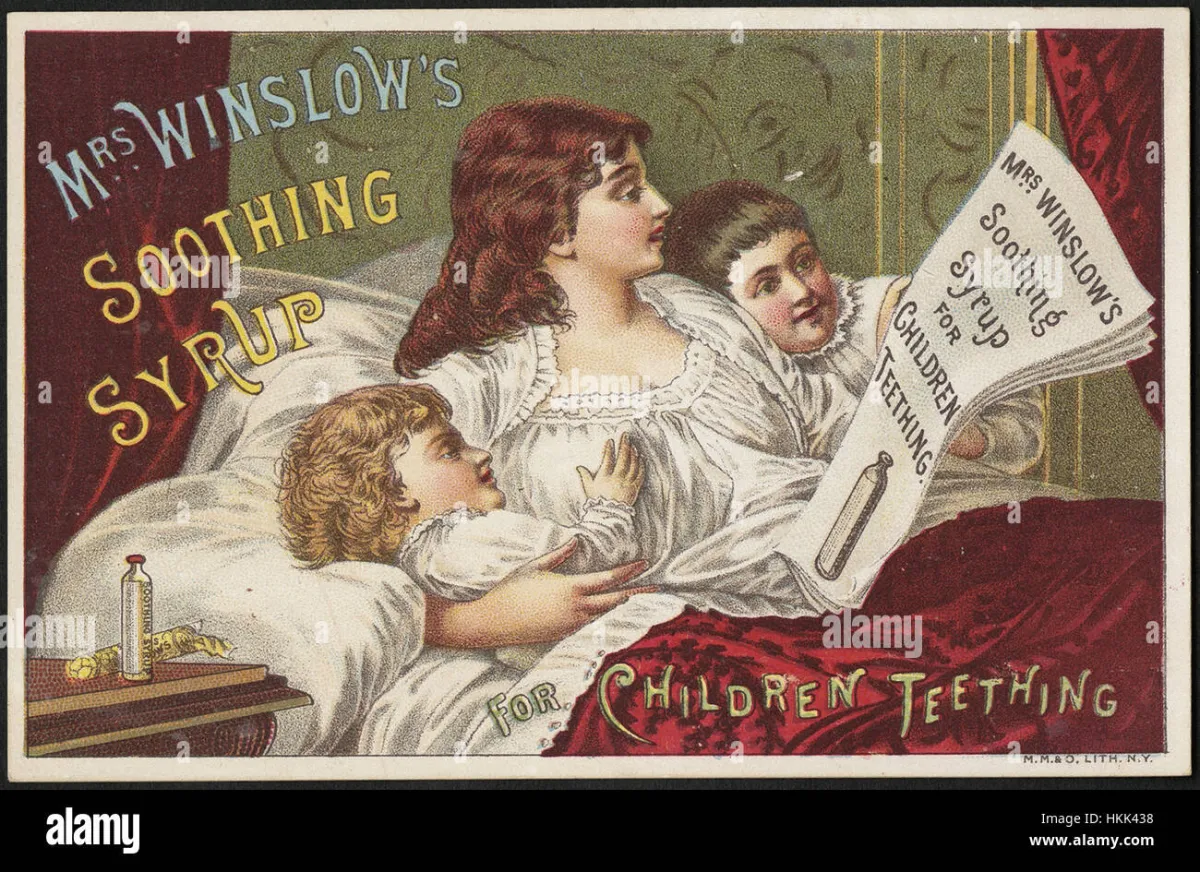 Photo: Mrs. Winslow's Soothing Syrup, via c8.alamy.com
The patent medicine era established the American pattern: identify a genuine medical problem, develop a chemical solution that provides immediate relief, market that solution as broadly as possible, and discover too late that widespread use creates problems larger than the original condition. This sequence would repeat itself with mechanical precision for the next century and a half.
The Barbiturate Years
The 1930s brought barbiturates, marketed as safe alternatives to alcohol for treating anxiety and insomnia. Doctors prescribed them freely, particularly to women experiencing what would now be recognized as depression or anxiety disorders. The pills worked exactly as intended—they calmed nerves and induced sleep. They also created physical dependence and carried a high risk of fatal overdose.
By the 1950s, barbiturate addiction had become a significant public health problem, but the medical response was not to question the underlying pattern. Instead, pharmaceutical companies developed new drugs to solve the barbiturate problem: tranquilizers like Miltown and Librium, marketed as non-addictive alternatives that could provide the same benefits without the same risks.
The tranquilizer boom of the 1950s and 1960s followed the identical script. Aggressive marketing to physicians emphasized safety and efficacy. Prescription rates soared as doctors used the new drugs to treat an expanding range of conditions. Popular culture celebrated "mother's little helper" as a modern solution to the stresses of contemporary life. Only gradually did it become clear that benzodiazepines carried their own addiction risks and withdrawal complications.
The Stimulant Solution
The 1970s brought a different category of problem drug: prescription stimulants for weight loss and attention disorders. Amphetamines had been used medically since the 1930s, but aggressive marketing expanded their use far beyond their original narrow indications. Diet pills containing amphetamines became a standard prescription for women seeking to lose weight. Stimulants were prescribed to children diagnosed with hyperactivity.
The pattern held: genuine medical utility, aggressive marketing, expanded use, and eventual recognition of widespread abuse potential. The diet pill epidemic of the 1970s created a generation of women dependent on prescription stimulants, while the early use of stimulants for childhood behavioral problems established the template for the ADHD medication controversies that continue today.
Each crisis generated the same institutional response: tighter regulations on the problematic drug, development of newer alternatives marketed as safer, and continued faith that the next pharmaceutical breakthrough would solve the problems created by the last one.
The Opioid Inevitability
The current opioid crisis is treated as a unique failure of corporate greed and regulatory oversight, but it belongs to this long American tradition. OxyContin was genuinely effective at treating severe pain. The problem was not that it failed to work as advertised, but that it worked exactly as advertised when prescribed to millions of patients for conditions ranging from dental surgery to chronic back pain.
The Purdue Pharma marketing campaign that convinced doctors to prescribe opioids more freely used the same arguments that had sold heroin, barbiturates, and tranquilizers in previous decades: undertreated medical conditions, safe and effective pharmaceutical solutions, and professional obligation to relieve patient suffering. The medical establishment embraced these arguments with the same enthusiasm their predecessors had shown for earlier pharmaceutical breakthroughs.
 Photo: Purdue Pharma, via seeklogo.com
What makes the opioid crisis distinctive is not its underlying mechanism but its scale. Previous episodes affected hundreds of thousands of Americans over periods of decades. The opioid epidemic has affected millions of Americans in a compressed timeframe, creating a public health emergency that finally forced recognition of the recurring pattern.
The Psychology of Medical Progress
The persistence of this cycle suggests something deeper than corporate malfeasance or regulatory failure. American medical culture treats each new pharmaceutical breakthrough as a fresh start rather than the latest iteration of a recurring pattern. The psychology of medical progress—the belief that science will eventually solve all human suffering—makes it difficult to learn from previous episodes.
Doctors want to relieve patient suffering. Patients want immediate relief from pain and distress. Pharmaceutical companies want to market effective products. These motivations are not inherently corrupt, but they create systematic pressure to maximize the use of any treatment that provides genuine benefits, regardless of long-term consequences.
The result is a medical culture that consistently mistakes short-term efficacy for long-term safety, and individual medical decisions for population-level public health outcomes. Each generation of physicians rediscovers the same lesson: drugs powerful enough to solve serious medical problems are also powerful enough to create serious medical problems when used at scale.
The pattern will almost certainly repeat with whatever pharmaceutical breakthrough comes next. The only question is whether American medical culture will finally learn to anticipate the consequences of its own success, or whether it will continue to treat each episode as an unprecedented failure rather than a predictable feature of how medicine interacts with human psychology at scale.