Five Times the Smartest Person in the Room Was the Last to See It Coming

Photo: expert analyst financial charts data overwhelmed office professional, via thumbs.dreamstime.com
There is a particular kind of catastrophe that does not arrive unannounced. It is telegraphed, sometimes for years, by signals that are visible to generalists, to outsiders, to people with no particular expertise in the relevant domain. And it is invisible, until the last possible moment, to the credentialed specialists whose entire professional identity is organized around understanding exactly this kind of system.
This is not a paradox. It is a predictable output of how expertise is built and what it costs.
Specialization requires investment — years of study, professional networks, institutional affiliations, and a worldview organized around the assumption that the field's foundational premises are sound. That investment creates genuine capability. It also creates a specific and measurable blind spot: the specialist who has spent twenty years mastering a system has twenty years of professional identity at stake in the system's continued operation. Seeing its fatal flaw is not merely an intellectual challenge. It is an existential one.
Human psychology has not changed in five thousand years. The physician who cannot diagnose a disease that would invalidate his training, the general who cannot imagine a war that his tactics cannot win, the financial engineer who cannot model a risk his models were not designed to capture — these are not historical curiosities. They are recurring characters, and history has been running the same experiment on them long enough to establish the results with confidence.
Here are five of the clearest cases.
1. The German General Staff and the War That Couldn't Last Six Weeks (1914)
The military planning apparatus that Europe assembled in the decades before 1914 represented the most sophisticated application of professional expertise to the problem of organized violence that the world had ever seen. The German Schlieffen Plan was a masterwork of logistical precision — a timetabled mobilization sequence that could move millions of men across a continent with railway-schedule accuracy.
What it could not do was account for the possibility that the war would not end in six weeks.
The plan's designers were not stupid. They were, by the standards of their field, brilliant. But their expertise was entirely organized around the problem of winning a short war, because the professional and institutional consensus of European military thinking held that modern industrial warfare was too expensive to sustain beyond a few months. Every model, every simulation, every staff exercise was built on that premise.
When the premise failed — when the lines stopped moving and the trenches began — the German high command spent four years attempting to apply short-war solutions to a long-war problem. The expertise that had made them the finest military planning organization in the world had also made them constitutionally incapable of reconceiving the nature of the conflict they were actually fighting.
The soldiers who understood that something had gone fundamentally wrong were the ones in the trenches. The last people to understand it were the ones with the most impressive credentials and the most to lose from the understanding.
2. The Physicians Who Could Not Diagnose Their Own Hospitals (1840s)
In the 1840s, Ignaz Semmelweis, a Hungarian physician working in Vienna, noticed that the maternity ward staffed by medical students and physicians had a mortality rate from puerperal fever three to five times higher than the ward staffed by midwives. He hypothesized that physicians were transmitting something from the autopsy room to the delivery room on their hands and instituted a handwashing protocol with chlorinated lime solution. Mortality in his ward dropped by roughly 90 percent.
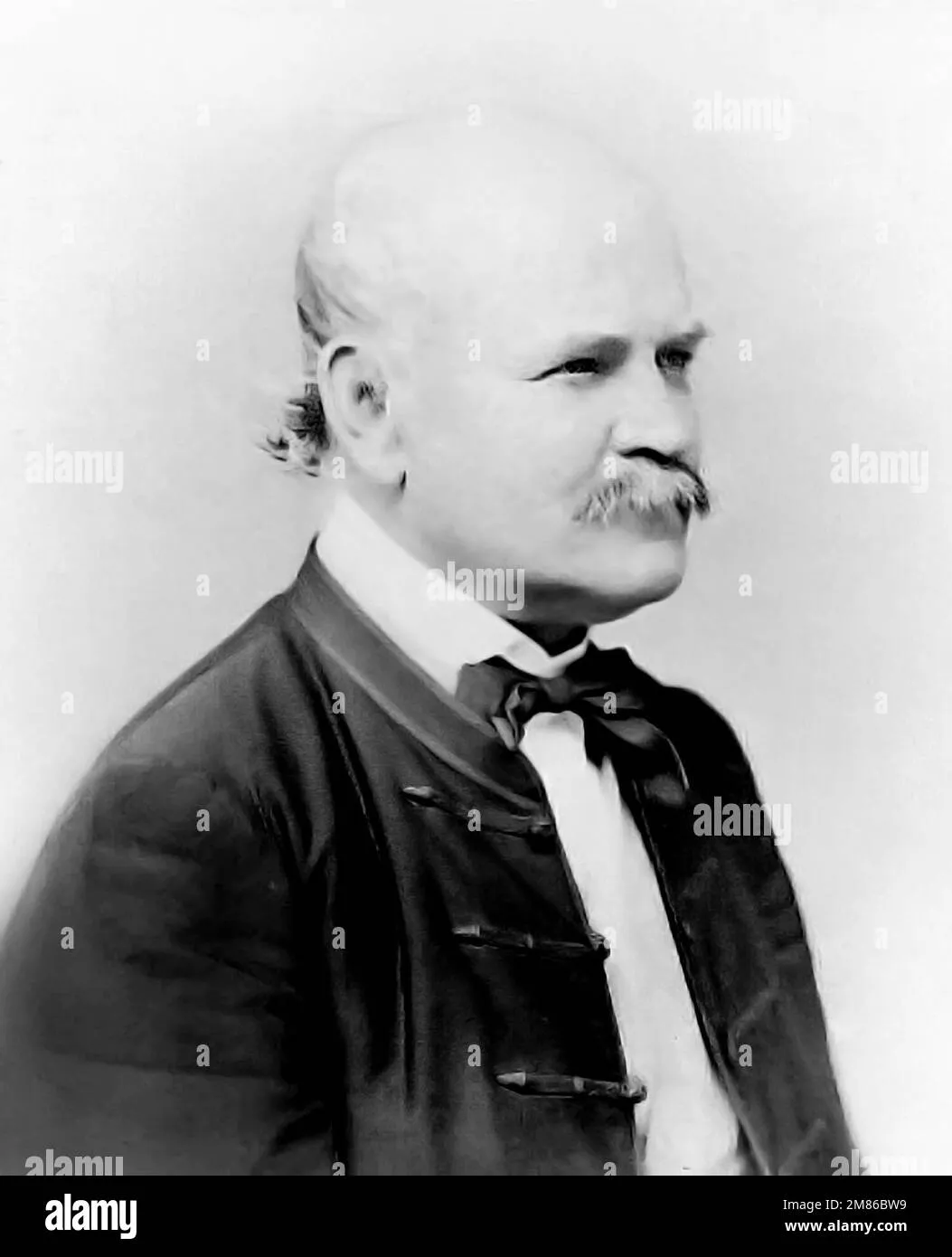 Photo: Ignaz Semmelweis, via c8.alamy.com
The medical establishment rejected his findings almost universally and subjected him to professional ridicule until his death in 1865.
The rejection was not irrational from the specialists' perspective. Semmelweis's hypothesis implied that physicians — the most trained, most credentialed practitioners in the medical system — were killing patients at a rate that untrained midwives were not. Accepting the evidence required accepting that the credential itself was, in this specific context, the danger. The investment in medical training, in the professional hierarchy, in the entire organizational structure of nineteenth-century medicine made that conclusion psychologically unavailable to those most qualified to evaluate it.
The midwives, who had no professional identity invested in the theory that physicians' hands were safe, had no difficulty observing the differential mortality. The specialists did.
3. The Maginot Line's Architects and the War They Designed For (1940)
The Maginot Line was not a failure of engineering. It was an engineering triumph — a marvel of reinforced concrete, retractable gun turrets, underground railways, and climate-controlled barracks that solved, with extraordinary thoroughness, the problem of defending France against a German attack along the Franco-German border.
The French military and political establishment that designed and funded it were not naive. They were deeply expert in the problem they had chosen to solve: preventing a repeat of the static frontier warfare that had consumed a generation of Frenchmen between 1914 and 1918. Their solution was technically correct for the war they had studied.
The German advance of May 1940 did not attack the Maginot Line. It went through the Ardennes, a route the French high command had assessed as impassable for armored formations. The assessment was made by specialists in the movement of large military forces who applied the logistical assumptions of the previous war to the capabilities of the current one.
Charles de Gaulle had been arguing since 1934 that mobile armored warfare would make fixed fortifications strategically obsolete. He was a relatively junior officer with no institutional standing in the French military's planning apparatus. His arguments were dismissed by the men whose expertise was most relevant to evaluating them — and whose professional investments made a favorable evaluation impossible.
4. The NASA Engineers Who Normalized the Data (1986)
The space shuttle Challenger was destroyed 73 seconds after launch on January 28, 1986, killing all seven crew members. The cause was the failure of an O-ring seal in cold temperatures — a failure mode that had been observed, documented, and discussed within NASA's engineering community for years before the disaster.
 Photo: Space Shuttle Challenger, via c8.alamy.com
The engineers at Morton Thiokol who manufactured the solid rocket boosters argued the night before the launch that temperatures forecast for launch day were outside the tested safety parameters for the O-ring seals. NASA management, under schedule pressure and operating within an institutional culture that had processed seventeen successful shuttle missions, responded by asking the engineers to prove that the O-rings would fail — reversing the standard burden of proof in safety engineering.
The engineers could not prove failure with certainty. They could only show a correlation between low temperatures and O-ring erosion. In the absence of a definitive proof of failure, the institutional expertise of NASA's management — experts in the shuttle program, in its track record, in the operational and political pressures surrounding the launch schedule — overrode the domain-specific warning.
The people with the most comprehensive view of the shuttle program's overall history saw seventeen successes and discounted a marginal risk. The people with the narrowest view — the O-ring engineers — saw a correlation that terrified them. Specialization, in this case, was the correct lens. Institutional expertise was the blindfold.
5. The Quant Desks and the Risk That Wasn't in the Model (2007–2008)
The financial engineers who designed and traded mortgage-backed securities and collateralized debt obligations in the years before 2008 were, in the technical sense, among the most sophisticated quantitative analysts ever employed in finance. Their models drew on decades of housing price data, default rate histories, and correlation assumptions that had been tested against every available historical data set.
The models were correct about everything they had been trained to measure. What they could not measure was a risk that had never appeared in the historical data: a synchronized, nationwide decline in housing prices. Every model assumed that regional housing markets were sufficiently uncorrelated that a national simultaneous collapse was outside the relevant probability distribution. The assumption was not unreasonable given the available history. It was catastrophically wrong given the actual structure of the market they had helped create.
The analysts who raised concerns before 2008 — Michael Burry, the small team at Deutsche Bank's mortgage department, a handful of hedge fund managers — were not better quants than the people at the major banks. In several cases, they were considerably less technically sophisticated. What they had that the specialists lacked was distance from the institutional investment in the models' validity.
The quants at the major banks were not merely running models. They were the models' creators, the models' defenders, and the primary beneficiaries of the models' continued credibility. Seeing the models' fatal assumption required seeing past all three of those investments simultaneously.
The Consistent Variable
Across five centuries and five radically different domains, the failure mode is identical. The specialist's expertise is genuine. The specialist's blind spot is not a lack of intelligence but a surplus of investment — in the system, in its premises, in the professional identity that the system's survival underwrites.
The corrective is not to distrust expertise. It is to build institutions that structurally separate the people who evaluate a system's risks from the people whose careers depend on the system's continued operation. History has been running this experiment for five thousand years. The results are not ambiguous.