The Roman Forum Had a Comment Section Too — And It Was Destroying People
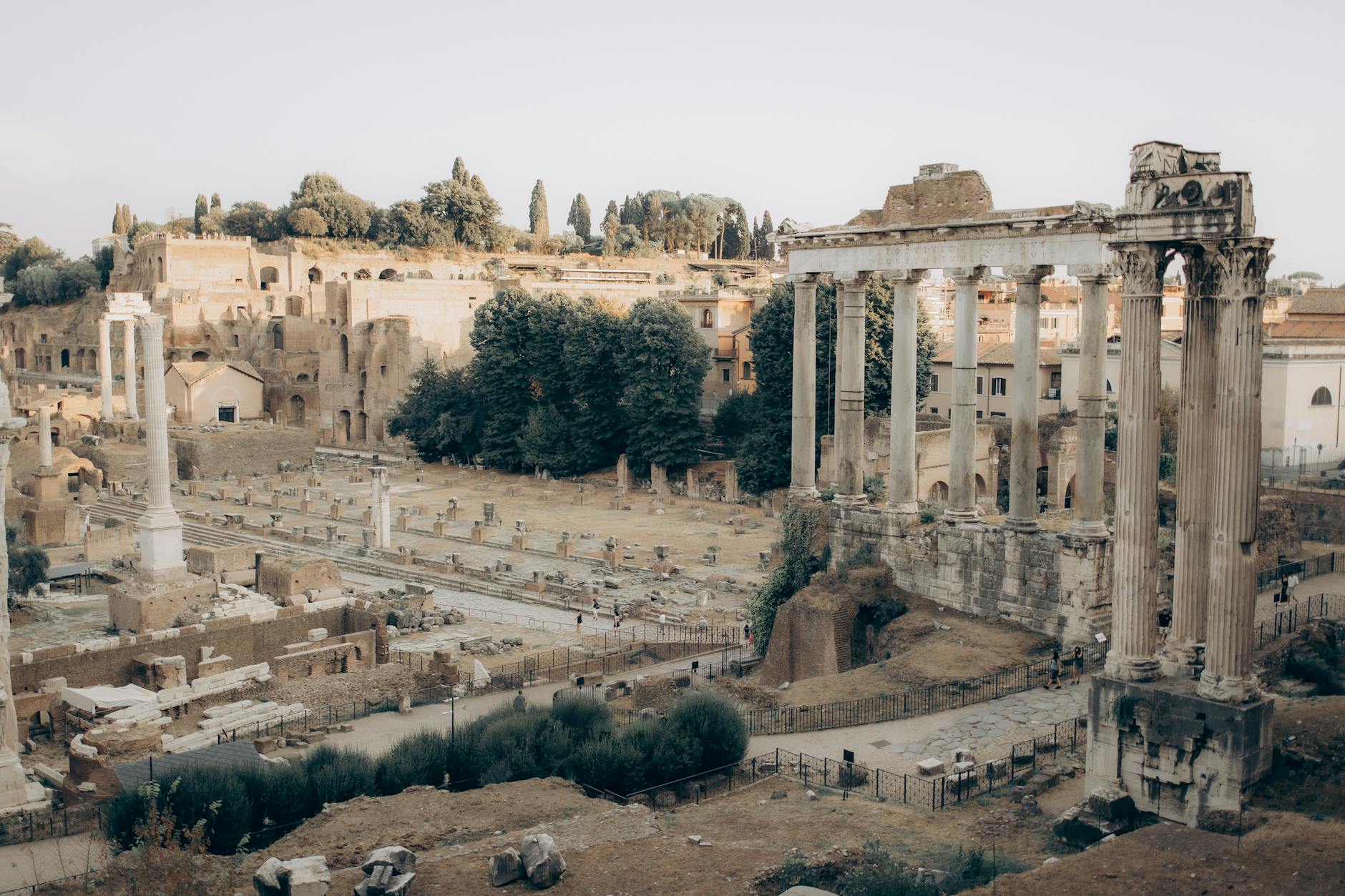
The Roman Forum Had a Comment Section Too — And It Was Destroying People
There is a comfortable myth embedded in most conversations about digital anxiety: that the problem is the technology. Smash the phones, the argument goes, and you smash the pathology. It is a tidy thesis. It is also almost certainly wrong.
History — which remains, by an extraordinary margin, the largest study of human behavior ever conducted — suggests that the architecture of dread is not a software problem. It is a hardware one. The nervous system sitting behind your eyes is running the same operating system it ran in 60 BCE, when a Roman citizen could stand in the Forum Romanum and receive, in the span of a single afternoon, seventeen conflicting rumors about the fate of the Republic, three predictions of imminent civil war, and a pamphlet arguing that everything had been better under the old ways.
Sound familiar?
The Forum as Feed
The late Roman Republic was, among other things, an information environment that had dramatically outpaced the human capacity to process it. Rome at its height was a city of roughly one million people — an almost incomprehensible scale for the ancient world — fed by a news infrastructure that included the Acta Diurna (an official daily gazette posted in public spaces), a dense network of letter-carriers connecting the city to its provinces, and the Forum itself, which functioned as a real-time aggregator of political gossip, financial speculation, and apocalyptic rumor.
The parallels to a modern social media feed are not metaphorical. They are structural. Information arrived faster than it could be verified. The loudest voices, not the most accurate ones, commanded the most attention. Catastrophic framings spread farther than mundane corrections. And the sheer volume of incoming signal — wars in Gaul, conspiracies in the Senate, grain shortages in the provinces — created what we would today recognize as a chronic low-grade state of threat activation.
Cicero, one of the most prolific writers of the period, documented this condition with an almost clinical precision in his private correspondence. Writing to his friend Atticus during the political convulsions of the 50s BCE, he described an inability to concentrate, a compulsive need to seek out the latest dispatches, and a persistent sense that each new piece of information, however alarming, was somehow insufficient. He needed more. He kept reading. The news kept being bad.
He was doomscrolling. He just did it with wax tablets.
Catastrophizing as a Rational Response to an Irrational Information Environment
It would be condescending to dismiss ancient anxiety as mere irrationality. The late Republic was collapsing. Caesar did cross the Rubicon. The civil wars were real. In this sense, the Roman citizen's threat-detection system was not malfunctioning — it was responding accurately to genuine instability.
This is a point that modern conversations about anxiety tend to elide. The problem is not that the human brain catastrophizes. The problem is that it catastrophizes at the same intensity whether the threat is existential or trivial, whether the collapsing institution is the Roman Senate or a company's quarterly earnings report. The system is not calibrated for scale. It was built for a village, and it has been asked to process an empire — or, in our case, the entire internet.
The Stoic philosophers who rose to prominence during precisely this period of Roman turmoil understood this mismatch intuitively, even if they lacked the neuroscientific vocabulary to name it. Marcus Aurelius, Epictetus, and Seneca were not offering abstract philosophical comfort. They were writing what amounted to cognitive-behavioral intervention guides for people drowning in an information environment that had exceeded human processing capacity.
Seneca's advice to his friend Lucilius — "Recede in te ipse", roughly, "Withdraw into yourself" — was not a counsel of apathy. It was a practical prescription for what we would now call attentional hygiene. Stop reading every dispatch. Stop attending every rumor. Distinguish between what is within your control and what is not, and allocate your attention accordingly.
The Stoics, in other words, invented the digital detox. They just had better prose.
Which Coping Strategies Actually Worked
History's advantage over the psychology laboratory is not merely scale — though five thousand years of documented human behavior does dwarf any sample of bored undergraduates completing surveys for course credit. Its deeper advantage is outcome data. We know what happened next.
The Romans who fared best during the convulsions of the late Republic were not, by and large, the ones who stayed most current. They were not the obsessive Forum-haunters, the men who read every Acta Diurna posting and attended every public speech. The historical record suggests, with some consistency, that the individuals who maintained clarity and effectiveness during periods of acute political instability shared several characteristics: they curated their information sources aggressively, they maintained strong personal networks built on demonstrated trust rather than proximity to power, and they distinguished sharply between the noise of daily events and the slower-moving structural forces that actually determined outcomes.
Cato the Younger read everything and raged at all of it. He was also, by most historical accounts, progressively less effective as the Republic deteriorated, his judgment clouded by the very thoroughness of his engagement with the chaos around him. Caesar, by contrast, was famously selective in his information diet — deeply informed on matters directly relevant to his decisions, deliberately indifferent to the ambient noise of Roman political gossip.
The lesson is not that ignorance is strength. It is that the volume dial on your information consumption is a strategic lever, not merely a wellness choice.
The Perennial Condition
Every generation believes, with complete sincerity, that it has invented anxiety. The evidence suggests otherwise. What changes across centuries is the delivery mechanism — stone tablets, pamphlets, newspapers, cable news, social media feeds — while the underlying dynamic remains remarkably stable: civilization generates more information than any individual can process, and the human nervous system responds to that surplus with a threat-detection cascade that it was never designed to sustain indefinitely.
The Roman Forum is gone. The comment section is not. And the philosophical traditions that emerged from that ancient information overload — the Stoics, the Epicureans, the various schools of deliberate withdrawal and selective attention — have survived precisely because they were solving a permanent problem, not a temporary one.
The technology will keep changing. The hardware will not. That is why the most useful thing a person drowning in the modern news cycle might do is put down the business self-help book and pick up Marcus Aurelius.
He had already run the experiment. He left notes.